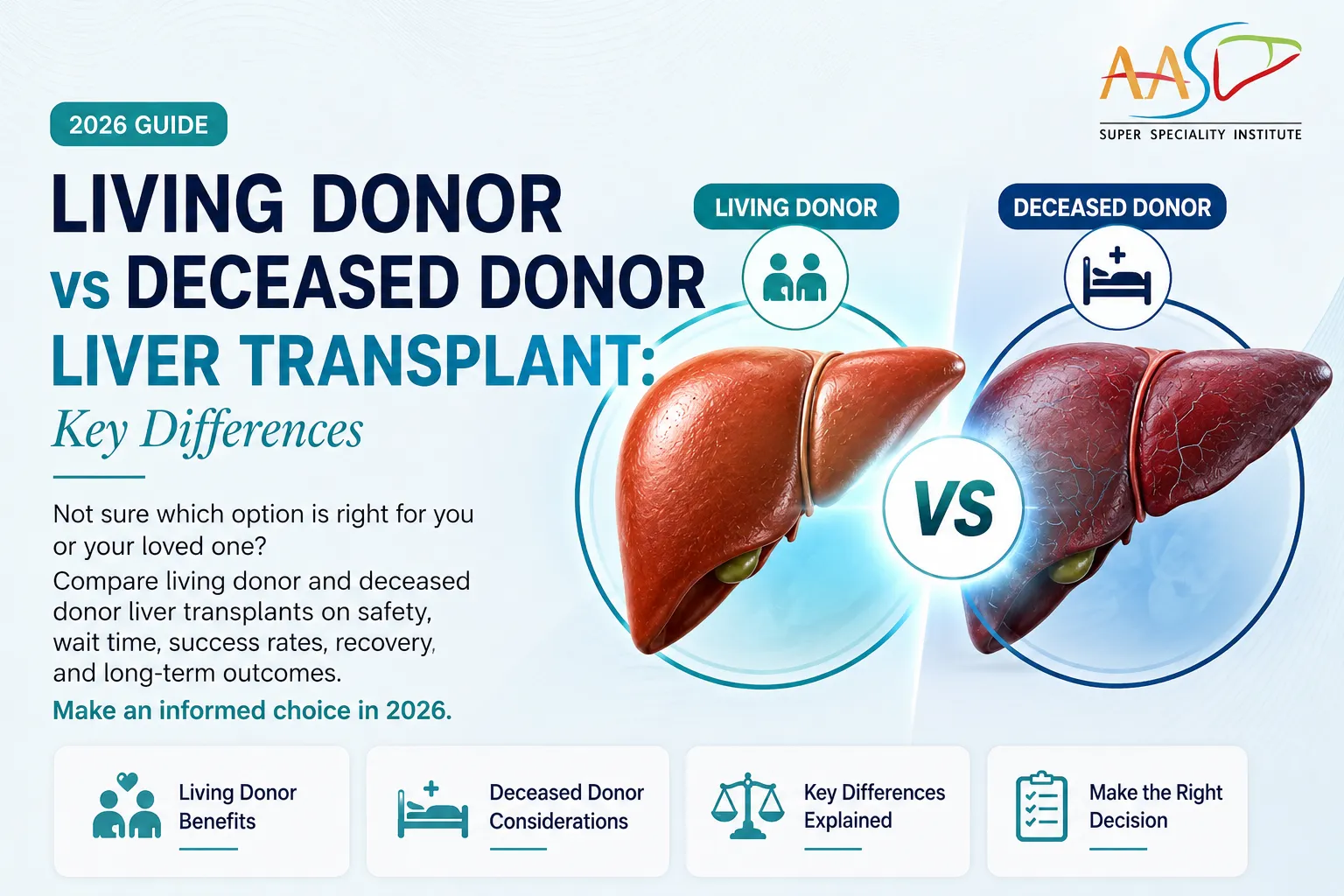
When a doctor first says the word “transplant,” most families hear it as one single decision. It isn’t. The very next question is which type of transplant — living donor or deceased donor — and that choice shapes everything from timelines to donor evaluation to how soon surgery can actually happen.
Here’s how the two options actually compare, without the textbook definitions you’ve probably already read three times this week.
The Real-World Difference: Waiting
This is usually the deciding factor for Indian families, more than anything else.
A deceased donor liver transplant (DDLT) depends on organ availability through the national deceased-donor programme. Depending on your blood group, the region you’re registered in, and how sick you are (measured by your MELD/PELD score), the wait can range from a few weeks to well over a year. For someone with decompensated cirrhosis or a rapidly worsening condition, that kind of uncertainty is dangerous — patients can deteriorate faster than a matching organ becomes available.
A living donor liver transplant (LDLT) removes that uncertainty. If a compatible, healthy donor comes forward — usually a close relative — surgery can be scheduled electively, often within weeks of donor clearance rather than months or years. This is a major reason LDLT has become the dominant transplant route in India, unlike in countries with larger deceased-donor programmes.
How Donor Safety Is Actually Assessed
A living donor isn’t just “a match” — they go through one of the most thorough medical workups a healthy person will ever have. This typically includes:
- Blood group and tissue compatibility testing
- CT volumetry to calculate exactly how much liver can be safely donated
- Cardiac, pulmonary, and psychological evaluation
- Independent counselling to confirm the decision is voluntary, not pressured
The liver’s ability to regenerate is what makes LDLT possible at all — both the donor’s remaining liver and the transplanted portion in the recipient typically regrow to near-full functional size within a couple of months. Still, it remains major surgery, and donor safety protocols exist precisely because this is someone healthy undergoing an operation for another person’s benefit.
If you’re exploring LDLT as an option, our page on liver transplant surgery at AASLT covers the full evaluation process for both donor and recipient in more depth.
Survival Outcomes: Is One Actually “Better”?
This is where a lot of online content oversimplifies things. Broadly, long-term survival rates for LDLT and DDLT are comparable when performed at experienced centres, generally sitting in the 90%+ range for one-year survival. What actually moves the needle more than “which type” is:
- How sick the patient was going into surgery
- Surgeon and centre experience with that specific transplant type
- Post-operative complication management, particularly biliary complications, which tend to be somewhat more common after LDLT due to the smaller, more complex bile duct anatomy involved
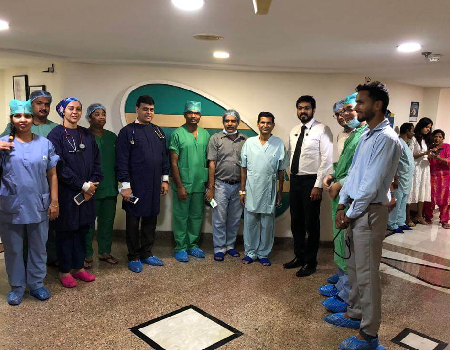
This is exactly why choosing an experienced team matters more than choosing a transplant “type” in the abstract. AASLT’s transplant programme is led by Dr. Vishal Kumar Chorasiya, who has performed over 2,500 liver transplants across 18+ years, with a specific focus on minimally invasive donor hepatectomy — donor surgery performed laparoscopically or robotically, which reduces donor scarring, pain, and recovery time considerably compared to traditional open donor surgery.
Who Typically Needs DDLT Instead of LDLT?
Living donation isn’t always possible or appropriate. DDLT tends to be the route when:
- No compatible living donor is available or willing
- The recipient needs a full-size liver (some adult patients require more liver volume than a single living donor lobe can safely provide)
- The living donor evaluation reveals a health risk that rules them out
In these situations, the patient is registered on the deceased-donor waiting list through the appropriate state or national organ-sharing authority, and monitored closely while waiting.
What About ABO-Incompatible Donors?
One development worth knowing about if your only willing donor has a different blood group: ABO-incompatible (ABOi) liver transplant allows transplantation across blood groups in selected cases, using pre-surgical treatment to reduce the recipient’s antibody levels. It’s a more specialised procedure with a higher immunological risk profile, but outcomes have improved significantly with modern protocols, and it has opened up living donation for families who previously had no compatible donor at all.
Making the Decision
There’s no universally “right” choice between LDLT and DDLT — it depends entirely on your specific situation: how urgent the need is, whether a safe donor exists in your family, and what your transplant team recommends after evaluating both options. According to the American Liver Foundation, the decision should always be individualised based on the recipient’s condition and donor availability rather than a fixed preference for one type over the other.
Frequently Asked Questions
Can a donor and recipient have different blood groups?
In standard LDLT, donor and recipient blood groups need to be compatible. ABO-incompatible transplant is a specialised exception used in select cases with additional pre-treatment.
Does the donor need to be a blood relative?
Regulations around unrelated living donation vary and typically require additional legal and ethical committee approval to rule out organ trade. Blood relatives generally have a more straightforward approval process.
How long does a living donor take to fully recover?
Most donors are back to normal activity within 4–8 weeks, though this varies with the surgical approach used and individual recovery pace.
Unsure which path fits your situation? Book a consultation with Dr. Vishal Kumar Chorasiya for an honest assessment based on your reports and donor availability.