Almost everyone knows someone who’s had “gallbladder problems,” but the symptoms get dismissed for months because they look so much like ordinary indigestion. That delay is the most common reason people end up in an emergency room instead of booking a planned surgery on their own schedule.
Here’s how to tell the difference — and what actually happens if you need gallbladder surgery.
What Are Gallbladder Stones, Exactly?
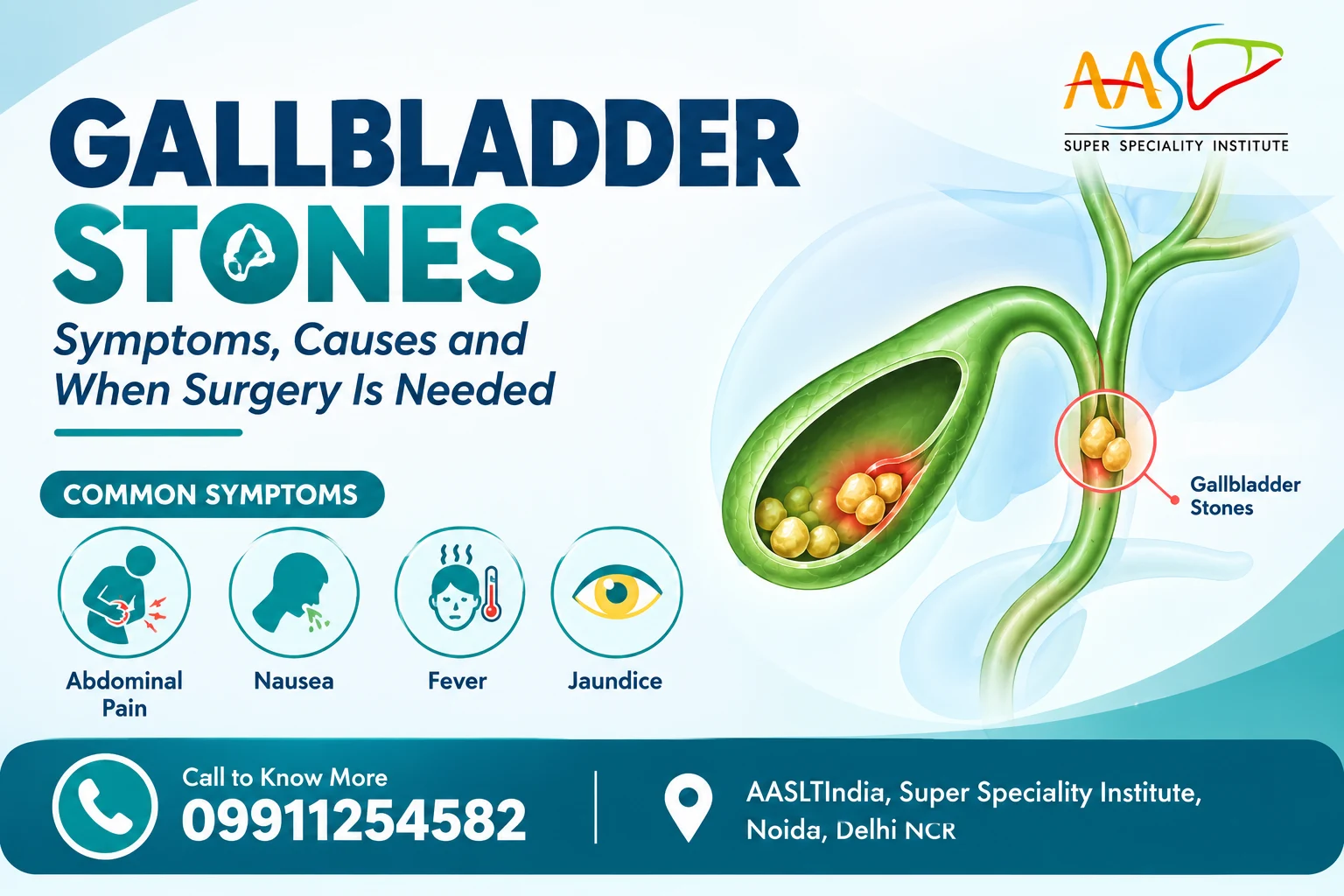
The gallbladder is a small pouch under your liver that stores bile, a fluid that helps digest fat. When substances in bile — usually cholesterol or bilirubin — crystallise, they form stones ranging from grain-of-sand size to something the size of a golf ball. Most people with gallstones never know they have them until a stone blocks the duct leading out of the gallbladder, which is when symptoms actually start.
Quick Self-Check: Mild Discomfort or Something Urgent?
Use this to gauge where you might fall, then read on for what each level actually means.
Mild / worth monitoring:
- Occasional bloating or fullness after fatty meals
- Mild discomfort in the upper right abdomen that comes and goes
- Nausea after a heavy or oily meal, without fever
Moderate / book a consultation soon:
- Pain in the upper right abdomen lasting more than 30 minutes, sometimes radiating to the right shoulder or back
- Repeated episodes after fatty food, even if each one resolves on its own
- Indigestion that’s become more frequent over the past few months
Urgent / seek care immediately:
- Severe, constant abdominal pain lasting several hours
- Fever with chills alongside abdominal pain (a sign of possible infection)
- Yellowing of the skin or eyes (jaundice)
- Vomiting that won’t stop, combined with abdominal pain
If you’re in the urgent category, don’t wait for a scheduled appointment — go to an emergency department. A blocked bile duct with infection (cholangitis) or an inflamed gallbladder (cholecystitis) can escalate quickly.
Why Gallstones Form
Some of the well-known risk factors include:
- Being female and over 40 (hormonal factors increase cholesterol concentration in bile)
- Obesity or rapid weight loss
- A diet high in refined carbohydrates and saturated fat
- Family history of gallstones
- Certain conditions like diabetes or liver disease that alter bile composition
None of these guarantee you’ll develop stones, and plenty of people with none of these risk factors still get them — the gallbladder doesn’t always play fair.
How Gallstones Are Diagnosed
An ultrasound of the abdomen is usually the first and most reliable test — it picks up gallstones with high accuracy and is quick, painless, and doesn’t involve radiation. If there’s suspicion the stone has moved into the bile duct itself (rather than staying in the gallbladder), additional imaging like an MRCP or an ERCP may be needed to locate and, in some cases, remove it endoscopically before gallbladder surgery.
When Does It Actually Need Surgery?
Not every gallstone needs to come out. Silent gallstones — found incidentally on a scan for an unrelated reason — are often just monitored if they’re not causing symptoms. Surgery becomes the recommended path when:
- You’ve had one or more symptomatic attacks (biliary colic)
- There’s evidence of gallbladder inflammation (cholecystitis)
- A stone has migrated into the bile duct causing blockage or jaundice
- You have complications like pancreatitis linked to gallstones
What the Surgery Involves
Laparoscopic cholecystectomy — removing the gallbladder through small keyhole incisions — is the standard approach today and has replaced open surgery for the vast majority of cases. Most patients go home within 24–48 hours and are back to normal activity within a week or two. The gallbladder isn’t essential for survival; bile simply flows directly from the liver to the intestine afterward, and most people notice no meaningful change in digestion once they’ve recovered.
In more complex cases — where a stone is stuck in the bile duct, or where there’s significant scarring from repeated inflammation — the approach may need to combine endoscopic duct clearance with surgical gallbladder removal. This is where having a surgical team experienced across both GI surgery and HPB (hepato-pancreato-biliary) procedures matters, since bile duct complications need more than routine gallbladder removal to manage safely.
At AASLT, gallbladder and bile duct surgery falls under the broader HPB and GI surgery programme led by Dr. Vishal Kumar Chorasiya, who brings 18+ years of hepatobiliary surgical experience — including complex bile duct reconstruction cases that go well beyond routine gallbladder removal — to even straightforward gallbladder cases, which is part of why complications are caught and managed early rather than after the fact.
Life After Gallbladder Removal
Most people adjust within a few weeks. Some notice mild changes in bowel habits (looser stools, especially after very fatty meals) in the early period, which typically settles as the body adapts to bile flowing continuously rather than being stored and released on demand. A gradual return to a normal diet, rather than avoiding fat altogether long-term, is generally what’s recommended.
According to the National Institute of Diabetes and Digestive and Kidney Diseases (NIDDK), most people who have gallbladder removal surgery do not experience any long-term digestive problems as a result.
Frequently Asked Questions
Can gallstones be dissolved without surgery?
Medication to dissolve cholesterol stones exists but works slowly, only for specific stone types, and stones often recur once medication stops. Surgery remains the definitive treatment for symptomatic stones.
Is gallbladder surgery safe for older adults?
Yes, laparoscopic cholecystectomy is generally well tolerated across age groups, though your surgical team will factor in other existing health conditions during pre-operative evaluation.
How soon can I eat normally after surgery?
Most patients resume a fairly normal diet within a few days, starting with lighter, low-fat meals and gradually returning to their usual diet over one to two weeks.
If you’re dealing with recurring abdominal discomfort after meals, it’s worth getting it checked before it becomes an emergency. Book a consultation with AASLT’s GI surgery team in Noida.