Key facts
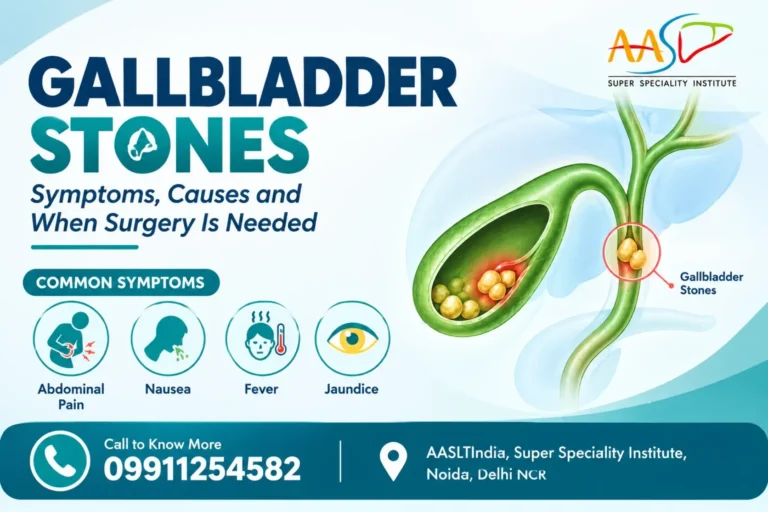
- Symptoms: Pain in the upper right abdomen after meals, nausea, fever, or jaundice if a stone slips into the bile duct.
- Surgery: Laparoscopic cholecystectomy through 3–4 small cuts, usually with a one-day hospital stay and return to work in about a week.
- When to act quickly: Fever with pain, jaundice or pancreatitis need urgent care.
- Who gets gallstones? Gallstones are very common in India, especially in women, people over 40, people with obesity or diabetes, and after rapid weight loss or pregnancy.
- When gallbladder surgery is needed: Repeated attacks of pain (biliary colic); Inflamed gallbladder (acute cholecystitis); Stones that have slipped into the bile duct or caused pancreatitis.
On this page
Symptoms
Pain in the upper right abdomen after meals, nausea, fever, or jaundice if a stone slips into the bile duct.
Surgery
Laparoscopic cholecystectomy through 3–4 small cuts, usually with a one-day hospital stay and return to work in about a week.
When to act quickly
Fever with pain, jaundice or pancreatitis need urgent care. In India, gallbladder cancer is more common in some regions, so thickened walls or large stones deserve review.
Who gets gallstones?
Gallstones are very common in India, especially in women, people over 40, people with obesity or diabetes, and after rapid weight loss or pregnancy. Many stones cause no symptoms and are found on an ultrasound done for another reason.
When gallbladder surgery is needed
- Repeated attacks of pain (biliary colic)
- Inflamed gallbladder (acute cholecystitis)
- Stones that have slipped into the bile duct or caused pancreatitis
- Polyps of 1 cm or more, or polyps that are growing
- A thick-walled or porcelain gallbladder, or suspected gallbladder cancer
Stones without symptoms usually do not need surgery, but very large stones, or living in a region with high rates of gallbladder cancer, can change that advice.
Before and after laparoscopic cholecystectomy
| When | What happens |
|---|---|
| Before | Ultrasound, blood tests, fitness check; fasting for about 6 hours |
| Operation | About 45–90 minutes through 3–4 small cuts under general anaesthesia |
| Same or next day | Walking, eating and going home |
| 1–2 weeks | Back to office work; avoid heavy lifting for about 4 weeks |
The gallbladder is not essential. Bile flows directly from the liver into the intestine, and most people eat normally afterwards.
Complex gallbladder and bile duct surgery
As HPB surgeons, the team handles difficult cases: severely inflamed gallbladders, stones in the bile duct, bile duct injuries from previous surgery, choledochal cysts and gallbladder cancer, which needs a radical operation removing part of the liver and nearby lymph nodes.
Frequently asked questions
Can gallstones go away without surgery?
No. Medicines rarely dissolve stones, and stones usually return when treatment stops. Surgery is the permanent solution for symptomatic stones.
Can I live normally without a gallbladder?
Yes. Most people eat a normal diet. A few notice looser stools after fatty meals for a few weeks.
How soon can I go back to work after gallbladder surgery?
Office work is usually possible after about a week; heavy physical work after about four weeks.
What is the diet after gallbladder removal?
Start with light, low-fat meals for the first week or two, then return gradually to a normal balanced diet.
Is gallbladder surgery safe?
Laparoscopic cholecystectomy is one of the most common operations, and serious complications are uncommon in experienced hands.

Group Director – Liver Transplant, HPB, GI & Robotic Surgery, Yatharth Group of Hospitals. 18+ years in liver transplantation.
This page is for general information and is not a substitute for medical advice. Speak to the transplant team for a personal assessment.