Key facts
- AASLT success rate: 95% (AASLT programme figure); experienced Indian centres report 85–90% one-year survival.
- What affects success: How sick the patient is at the time of transplant (MELD score); Age, heart and kidney function; Quality and size of the donor graft.
- How to compare centres: Ask for survival by year, the number of transplants per year, and how complications are reported.
- What “success” means after a transplant: Centres measure success in different ways, which is why one percentage can mean different things.
- How you can improve your own chances: Come for evaluation early, before the MELD score climbs; Stay alcohol-free and keep nutrition and muscle strength up before surgery; Take anti-rejection medicines exactly on time, every day.
- How Indian outcomes compare: Published survival at experienced Indian centres is broadly comparable with transplant programmes in the United States and Europe.
On this page
Our outcomes
| Measure | Figure | Basis |
|---|---|---|
| AASLT liver transplant success rate | 95% | AASLT programme figure, as published by Dr Chorasiya’s team |
| 1-year survival, experienced Indian centres | 85–90% | Published outcomes from Indian transplant centres |
| 5-year survival, experienced Indian centres | 70–75% | Published outcomes from Indian transplant centres |
Survival figures depend on how sick patients are at the time of transplant. When you compare centres, ask for the period and the number of patients behind each figure.
What affects success
- How sick the patient is at the time of transplant (MELD score)
- Age, heart and kidney function
- Quality and size of the donor graft
- Team experience and ICU support
- Taking medicines exactly as prescribed after discharge
How to compare centres
Ask for survival by year, the number of transplants per year, and how complications are reported. A centre that shares its methodology is more trustworthy than one quoting a single percentage.
What “success” means after a transplant
Centres measure success in different ways, which is why one percentage can mean different things. Ask which measure a figure refers to:
- Patient survival: the share of recipients alive one or five years after transplant
- Graft survival: the share whose transplanted liver is still working
- Donor safety: the rate of serious complications in living donors
- Quality of life: return to work, school and normal activity
How you can improve your own chances
- Come for evaluation early, before the MELD score climbs
- Stay alcohol-free and keep nutrition and muscle strength up before surgery
- Take anti-rejection medicines exactly on time, every day
- Attend every follow-up visit and blood test in the first year
- Report fever, jaundice or reduced urine the same day
How Indian outcomes compare
Published survival at experienced Indian centres is broadly comparable with transplant programmes in the United States and Europe. India also performs more living donor liver transplants than almost any other country, so its surgical teams have deep experience with this operation.
Frequently asked questions
Is a 95% success rate realistic?
AASLT reports a 95% success rate. Published one-year survival at experienced Indian centres is 85–90%; any centre’s figure depends on how sick its patients are at transplant.
What is the success rate of liver transplant in India?
Experienced Indian centres commonly report one-year survival of 85–90% and five-year survival of 70–75%. AASLT reports a 95% success rate.
How long can you live after a liver transplant?
Many recipients live for 20 years or more with a good quality of life, especially when they take their medicines correctly and attend follow-up.
Is living donor transplant as successful as deceased donor transplant?
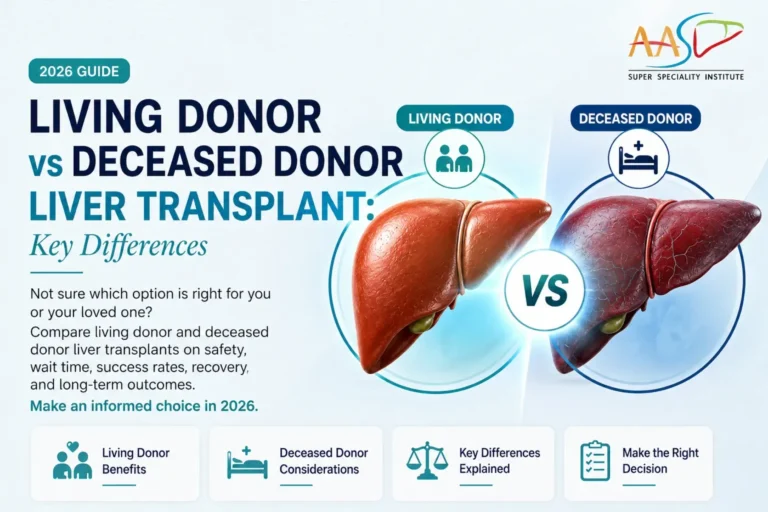
Outcomes are broadly similar. A living donor transplant can be planned before the patient becomes very sick, which can be an advantage.
Does age affect success?
Age alone is not a barrier; overall fitness, heart and kidney function matter more. Each patient is assessed individually.

Group Director – Liver Transplant, HPB, GI & Robotic Surgery, Yatharth Group of Hospitals. 18+ years in liver transplantation.
This page is for general information and is not a substitute for medical advice. Speak to the transplant team for a personal assessment.