
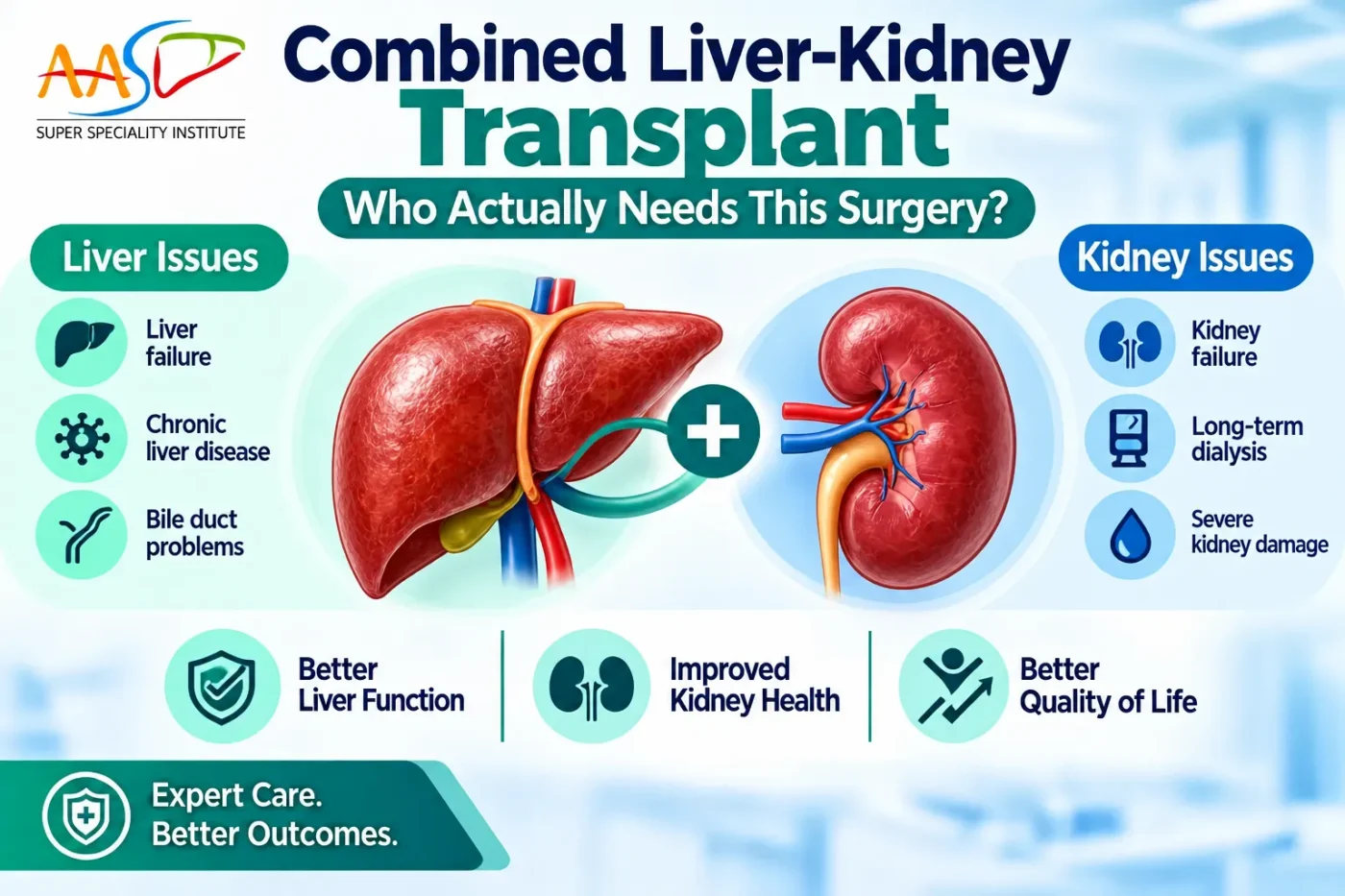
Most conversations about liver transplant assume one organ is the problem. But for a smaller group of patients, kidney function fails alongside the liver, and a liver transplant alone won’t fix what’s actually going wrong in the body. For them, a combined liver-kidney transplant (CLKT) is a genuinely different, more complex operation — and understanding why it’s needed matters as much as the surgery itself.
Why the Liver and Kidneys Fail Together
The liver and kidneys are more interconnected than most people realise. Severe liver disease can directly affect kidney function through a condition called hepatorenal syndrome, where advanced liver failure disrupts blood flow to the kidneys, causing them to fail even though the kidneys themselves may have no primary disease of their own. In these cases, a liver transplant alone can sometimes allow kidney function to recover — but not always, and predicting which patients will recover kidney function after a liver-only transplant is notoriously difficult.
Beyond hepatorenal syndrome, several other conditions genuinely damage both organs independently and require both to be replaced together:
- Polycystic liver and kidney disease, a genetic condition where cysts progressively destroy both organs
- Certain metabolic diseases that affect both liver and kidney function
- Long-standing diabetes or hypertension combined with advanced liver disease, where kidney damage has become independent and permanent
- Patients already on long-term dialysis whose kidneys show no meaningful chance of recovery even after a successful liver transplant
How Doctors Decide If CLKT Is Necessary
This decision isn’t made lightly, because a combined transplant is a bigger, more complex operation than a liver transplant alone, and organs are a scarce resource that need to go to the patients who will benefit most. Transplant teams typically look at:
- How long the patient has been on dialysis and whether kidney function shows any signs of recovery
- Kidney biopsy findings, where available, to assess whether the kidney damage looks reversible or permanent
- The specific underlying diagnosis — some conditions clearly require both organs; others are more of a judgment call
- Overall fitness for a longer, more demanding surgery, since CLKT takes longer and carries a higher immediate surgical burden than a single-organ transplant
What the Surgery Actually Involves
In a combined liver-kidney transplant, both organs are typically transplanted in the same operation, usually from the same deceased donor, in a carefully sequenced procedure — the liver is generally transplanted first, followed by the kidney. This coordinated approach avoids the need for two entirely separate major surgeries and their associated risks, and research has shown that receiving both organs from the same donor in one operation tends to reduce the kidney’s risk of rejection compared to a kidney transplanted separately at a later date.
Recovery involves a longer initial hospital stay than a liver transplant alone, closer monitoring of both organs’ function in the early weeks, and a somewhat more involved immunosuppression regimen — though for patients who genuinely need both organs, the alternative (a liver transplant with kidneys that never recover, requiring lifelong dialysis afterward) is a far harder path.
Why This Needs a Highly Experienced Team
Combined liver-kidney transplant sits at the more complex end of transplant surgery. It requires close coordination between liver transplant surgeons, kidney transplant/urology teams, nephrologists, and intensive care specialists, along with a centre experienced enough to manage two organs’ worth of post-operative complications simultaneously. This is precisely the kind of case that many smaller transplant programmes refer elsewhere rather than attempt themselves.
At AASLT, complex and multi-organ transplant cases are evaluated as part of the broader liver transplant programme, with Dr. Vishal Kumar Chorasiya’s 18+ years and 2,500+ liver transplants providing the depth of surgical experience needed to assess whether a patient’s kidney failure is likely to recover after a liver transplant alone, or whether CLKT is genuinely the safer, more definitive path. Being an Associate Member of the International Liver Transplantation Society (ILTS) also means staying current with evolving international protocols for exactly these complex, multi-organ decisions.
What Life Looks Like After CLKT
Patients who receive a combined transplant follow a similar long-term path to single-organ recipients — lifelong immunosuppression, regular monitoring of both liver and kidney function, and a gradual return to normal activity over the following months. The major difference is what they’re avoiding: without a functioning kidney, many of these patients would otherwise face lifelong dialysis, a demanding treatment in its own right, alongside their liver disease.
According to research published through the International Liver Transplantation Society, combined liver-kidney transplant has become an increasingly refined option as outcomes data has matured, though patient selection remains critical to achieving good results for both organs.
The Waiting List Question Families Always Ask
Because CLKT needs a donor whose liver and kidneys are both usable, families understandably worry this means a longer wait than a liver-alone transplant. In practice, most allocation systems, including India’s, give combined-organ candidates a form of priority precisely because their situation is more urgent and their need for two matching organs is harder to fulfil by definition. This doesn’t eliminate the wait, but it does mean CLKT candidates aren’t simply competing on equal footing with single-organ candidates for the same donor pool.
What families can control in the meantime is making sure the patient is registered, medically optimised, and getting dialysis managed as well as possible while waiting — since arriving at transplant in better overall condition genuinely improves how well someone tolerates a longer, more complex surgery.
Is CLKT Always the Right Call?
Not every patient with liver and kidney trouble needs both organs replaced. Some kidney dysfunction in severe liver disease is genuinely reversible once the liver itself is transplanted — this is part of what makes the decision complex rather than automatic. A transplant nephrologist typically gets involved specifically to help answer this question, sometimes using kidney biopsy findings or a trial period of dialysis to see whether kidney function shows any sign of stabilising before committing to a combined transplant listing. Getting this judgment right matters both ways: transplanting a kidney a patient didn’t need exposes them to unnecessary surgical risk and lifelong extra immunosuppression considerations, while under-treating a patient who genuinely needed both organs leaves them facing dialysis indefinitely after what was meant to be a curative liver transplant.
This is precisely why CLKT decisions at AASLT involve nephrology input alongside the transplant surgical team from the earliest stages of evaluation, rather than treating it as a surgical decision made in isolation. According to the National Kidney Foundation, careful pre-transplant assessment of kidney function is one of the most important factors in determining whether combined transplant will benefit a specific patient, since not every case of impaired kidney function in liver disease is permanent.
Frequently Asked Questions
Does a combined transplant mean a longer wait for a donor organ?
It can, since it requires a donor whose liver and kidneys are both suitable, and allocation systems typically prioritise these cases carefully given the complexity involved.
Is recovery from CLKT much harder than a liver transplant alone?
The initial hospital stay and early recovery are generally more demanding, given two organs are involved, but many patients go on to do very well long-term, particularly compared to the alternative of ongoing dialysis after a liver-only transplant.
Can a living donor provide both a liver segment and a kidney?
In principle, a living donor liver segment can come from one donor, but combined transplants overwhelmingly use deceased donor organs given the complexity of coordinating two living donations safely.
Will kidney function ever recover after a liver-only transplant, avoiding the need for CLKT altogether?
Yes, in a meaningful number of patients with hepatorenal syndrome, kidney function improves once the new liver restores normal blood flow and metabolic balance. This is exactly why careful nephrology assessment before transplant matters — to distinguish patients likely to recover kidney function from those who genuinely need both organs replaced.
If you or a family member has been told kidney function is declining alongside liver disease, speak with our transplant team or read more about our approach to complex liver transplant.