

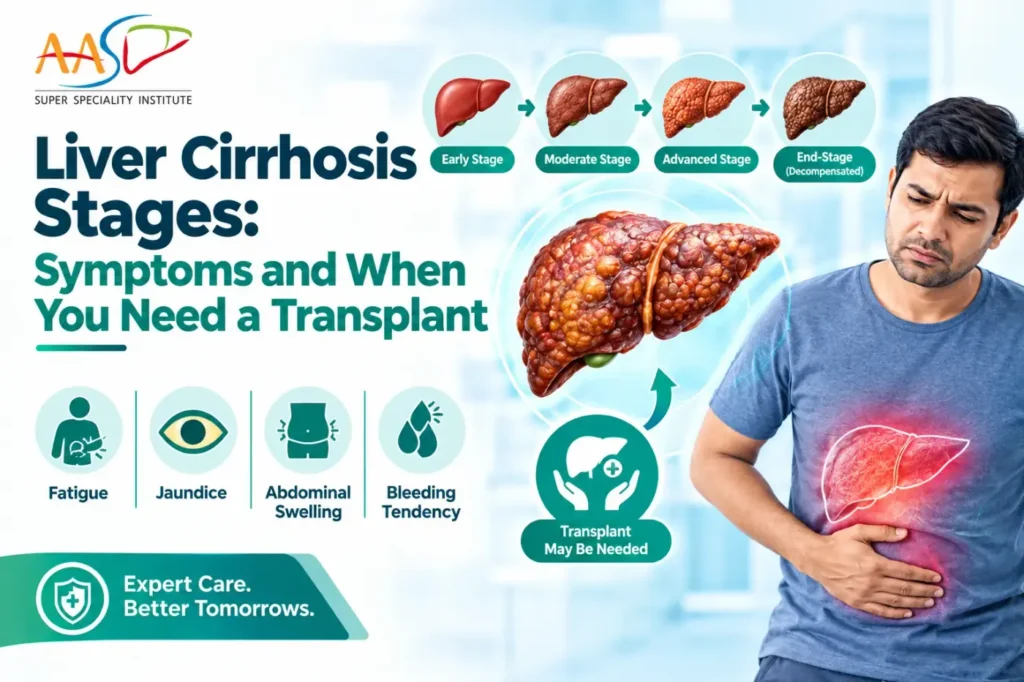
“Cirrhosis” is one of those words that sounds like a single, fixed diagnosis, but it’s actually a spectrum. Two people with cirrhosis can be living completely different realities — one going about daily life with minor dietary changes, the other in and out of hospital with serious complications. Understanding where someone sits on that spectrum is exactly what determines the right treatment path, including whether it’s time to start thinking about a transplant.
What Cirrhosis Actually Is
Cirrhosis is the result of long-term liver damage where healthy liver tissue is gradually replaced by scar tissue. This scarring disrupts the liver’s normal architecture, blocking blood flow through the organ and impairing its ability to perform its hundreds of functions — filtering toxins, producing proteins, regulating clotting, and more.
Common causes leading to cirrhosis in India include chronic Hepatitis B and C, long-term alcohol use, and increasingly, non-alcoholic fatty liver disease (NAFLD) progressing through NASH over many years.
Stage One: Compensated Cirrhosis
This is the stage most people don’t realise they’re in. The liver has scarring, but it’s still managing to perform most of its essential functions — hence “compensated.” Patients in this stage often have:
- Little to no noticeable symptoms
- Normal or near-normal blood test results in many cases
- Cirrhosis often discovered incidentally through imaging done for another reason, or through routine monitoring in someone with known chronic liver disease
This is genuinely the best stage to catch cirrhosis, because the goal here is to prevent — or significantly slow — progression to the next stage. Treating the underlying cause (antivirals for hepatitis, complete alcohol cessation, aggressive management of NAFLD risk factors) can meaningfully extend the time a patient stays compensated, sometimes for years or even indefinitely.
The Turning Point: Compensated to Decompensated
This transition is the single most important moment in the entire disease course, and it’s exactly why regular monitoring matters even when someone feels fine. Decompensation means the liver’s scarring has progressed to the point where it can no longer keep up with the body’s demands, and this typically shows up through one or more specific complications rather than a vague “feeling worse.”
Stage Two: Decompensated Cirrhosis
This stage is marked by the appearance of specific complications, including:
- Ascites — fluid accumulation in the abdomen, often the first visible sign of decompensation
- Variceal bleeding — enlarged, fragile veins (usually in the oesophagus) that can rupture and bleed, sometimes severely
- Hepatic encephalopathy — confusion or altered mental state caused by toxins the liver can no longer clear effectively
- Jaundice — yellowing of the skin and eyes, reflecting the liver’s declining ability to process bilirubin
- Recurrent infections, since a decompensated liver also affects immune function
Once decompensation occurs, this is generally considered the point where transplant evaluation should begin — not necessarily immediate transplant, but the process of assessment, MELD scoring, and donor discussion, because decompensated cirrhosis carries a significantly higher risk of life-threatening complications and the window to plan a transplant properly is far better used early than in a crisis.
How Doctors Track Where a Patient Sits on This Spectrum
The MELD score (Model for End-Stage Liver Disease) is the standard tool used to quantify how advanced a patient’s liver disease is, based on bilirubin, creatinine, and INR (a clotting measure). It’s used both to guide urgency of treatment and to prioritise patients on deceased-donor transplant waiting lists. A rising MELD score over successive visits is one of the clearest signals that a patient’s disease is progressing and that transplant conversations need to move from “someday” to “soon.”
Why Waiting Too Long Is the Most Common Mistake
A recurring pattern we see: patients and families delay starting the transplant evaluation process because the patient “still feels okay” between complications, or because the idea of transplant feels premature. The problem is that transplant evaluation itself — donor workup, compatibility testing, medical clearance — takes time, and starting it only once a patient is critically ill removes options and adds risk. Beginning the conversation early, ideally as soon as decompensation is diagnosed, gives families the time to explore living donor options properly rather than scrambling under pressure.
At AASLT, this is a conversation Dr. Vishal Kumar Chorasiya has with families regularly — helping them understand that decompensation is the signal to start planning, not the signal to panic, and that the actual transplant timeline can often be managed calmly if the process starts at the right point. With over 18 years managing patients across this entire spectrum, from newly diagnosed compensated cirrhosis to complex re-transplant cases, the team’s approach is built around not letting patients reach a crisis point before transplant options are even discussed. You can read more about the transplant evaluation and surgical process on our liver transplant page, and about the range of underlying liver conditions on our liver diseases page.
Can Decompensated Cirrhosis Ever Improve?
In select cases — particularly when the underlying cause is actively treatable, such as alcohol-related cirrhosis with complete alcohol cessation, or Hepatitis B/C brought under control with antivirals — some degree of improvement (referred to as “recompensation”) is possible, and a patient may stabilise without needing immediate transplant. This isn’t guaranteed, and it depends heavily on how much irreversible scarring has already occurred, which is why every case needs individual assessment rather than a generic answer.
According to the American Liver Foundation, roughly 5-year survival rates differ dramatically between compensated and decompensated cirrhosis, underscoring why the distinction between these two stages is one of the most clinically important pieces of information a patient with cirrhosis can have about their own condition.
Frequently Asked Questions
How long can someone live with compensated cirrhosis?
This varies widely depending on the underlying cause and how well it’s managed, but many patients with compensated cirrhosis live for years, sometimes decades, particularly if the underlying cause is treated effectively.
Is decompensated cirrhosis always fatal without a transplant?
Not immediately, but it significantly shortens life expectancy compared to compensated cirrhosis, and management focuses on treating complications while working toward transplant evaluation for eligible patients.
Can lifestyle changes reverse cirrhosis?
Established scarring generally isn’t reversible, but stopping the underlying cause of damage (alcohol, uncontrolled hepatitis, unmanaged NAFLD) can prevent further progression and, in some cases, allow partial functional improvement.
If you or a family member has been diagnosed with cirrhosis, understanding which stage you’re at changes everything about the plan going forward. Book a consultation with AASLT’s liver specialists for a clear assessment.