
A hernia diagnosis tends to trigger one of two reactions: either people panic and want it fixed immediately, or they decide it’s “not that bad yet” and put off surgery for months, sometimes years. Neither reaction is really based on knowing what the surgery involves. Here’s the plain-language version.
What a Hernia Actually Is
A hernia happens when an internal organ or tissue — usually part of the intestine or abdominal fat — pushes through a weak spot in the surrounding muscle wall. You’ll often notice it as a visible bulge, especially when standing, coughing, or straining, that may reduce or disappear when lying down.
The most common types are:
- Inguinal hernia — in the groin, far more common in men, and the single most frequently repaired hernia type
- Umbilical hernia — around the belly button, common in both adults and children
- Ventral/incisional hernia — occurring at the site of a previous surgical incision, where the abdominal wall hasn’t fully healed back to full strength
- Hiatal hernia — a different category entirely, where part of the stomach pushes up through the diaphragm, usually managed differently from the abdominal wall hernias above
Why Hernias Don’t Fix Themselves
Once a weak spot in the muscle wall has given way, it doesn’t heal back on its own — there’s no medication or exercise that closes a hernia defect. It can stay the same size for a while, or it can gradually enlarge over time as pressure continues to push through the same weak point. This is exactly why “just monitor it” has a shelf life as a strategy — most hernias eventually need surgical repair, and the longer they’re left, the larger and sometimes more complicated they can become to fix.
When It Becomes an Emergency
Most hernias aren’t urgent, but a specific complication is: a hernia that becomes incarcerated (stuck, unable to be pushed back in) or strangulated (its blood supply cut off). Signs of this include sudden, severe pain at the hernia site, the bulge becoming hard and tender, nausea and vomiting, or the bulge changing colour. This needs emergency surgery, not a scheduled appointment — strangulation can cause tissue death within hours if untreated.
Why Laparoscopic Repair Has Become the Preferred Approach
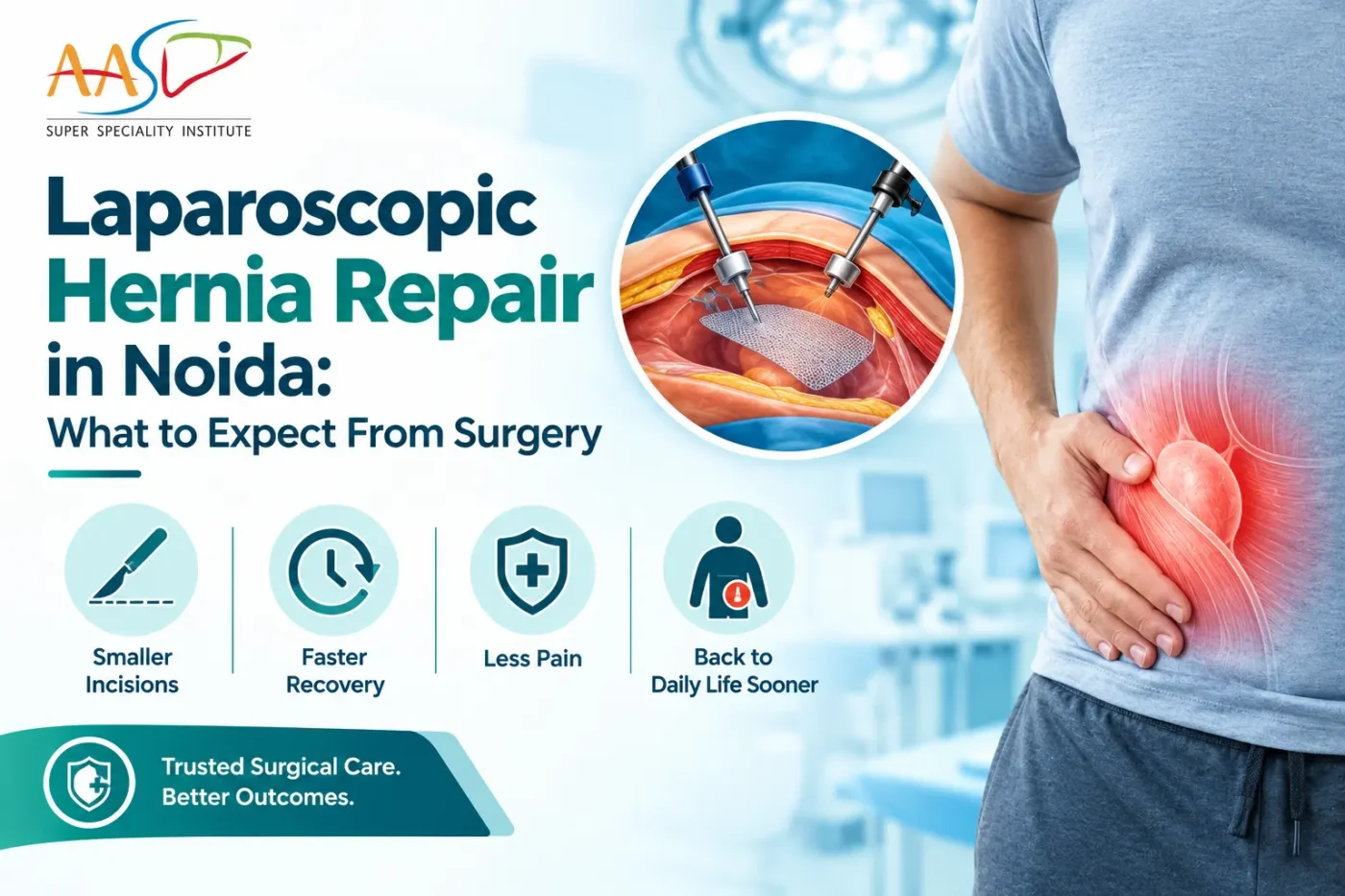
Hernia repair has traditionally been done as open surgery, through a single larger incision directly over the hernia. Laparoscopic hernia repair, done through a few small keyhole incisions using a camera and specialised instruments, has become the preferred approach for many patients because it generally offers:
- Less post-operative pain compared to open repair
- Smaller scars and less visible surgical trauma
- Faster return to normal activity, often within 1-2 weeks rather than several weeks
- Particularly strong outcomes for recurrent or bilateral hernias (hernias on both sides), where laparoscopic access allows both to be repaired through the same small incisions
That said, not every hernia is best suited to a laparoscopic approach — very large hernias, certain incisional hernias, or specific anatomical considerations sometimes make open repair the more appropriate choice. This is a decision your surgeon makes based on your specific hernia’s size, location, and history, not a one-size-fits-all default.
What the Surgery Actually Involves
In most laparoscopic hernia repairs, the surgeon places a surgical mesh over the weakened area of the abdominal wall to reinforce it, rather than simply stitching the defect closed — mesh repair has significantly lower recurrence rates than suture-only repair for most hernia types. The mesh is placed through the small keyhole incisions and secured in position, and over the following weeks, the body’s own tissue grows into it, creating a durable, reinforced repair.
The procedure is typically done under general anaesthesia and most patients go home the same day or after one night in hospital.
A Realistic Recovery Timeline
- First few days: Mild to moderate discomfort at the incision sites, manageable with prescribed pain medication; light walking is encouraged early to reduce clot risk
- First 1-2 weeks: Gradual return to normal daily activities; avoiding heavy lifting or strenuous exercise during this period
- 2-4 weeks: Most patients are back to work and regular activity, depending on how physically demanding the job is
- 4-6 weeks: Full return to strenuous activity and heavy lifting, once the surgical site has adequately healed
Every patient’s pace differs based on age, overall fitness, and the size and complexity of the hernia repaired.
Why Surgeon Experience Matters Here Too
While hernia repair is more routine than complex liver or pancreatic surgery, outcomes — particularly recurrence rates and complication rates — are still meaningfully linked to surgical volume and technique. Laparoscopic hernia repair specifically has a learning curve, and centres that perform it regularly tend to see better long-term results than those that do it occasionally.
At AASLT, hernia repair is part of the broader HPB and GI surgery programme in Noida, with both laparoscopic and open techniques available depending on what’s appropriate for each patient’s specific hernia. According to Johns Hopkins Medicine, most patients recover well from hernia surgery and can return to normal activities within a few weeks, particularly with a minimally invasive approach when it’s a good fit for the case.
What Actually Happens If You Keep Putting It Off
A lot of people manage a small, stable hernia for years with no real trouble, and it’s fair to wonder whether surgery is really necessary if it isn’t currently bothering you. The honest answer is that risk isn’t fixed — it tends to increase gradually over time. As a hernia enlarges, more tissue pushes through the defect, which both increases discomfort and increases the chance of that tissue eventually getting stuck (incarcerated). A larger hernia is also generally a technically more involved repair than a smaller one caught earlier, sometimes requiring a bigger piece of mesh or a more extensive dissection to fix properly.
None of this means every hernia needs immediate surgery — small, genuinely asymptomatic hernias in older or higher-risk patients are sometimes reasonably managed with watchful waiting under a surgeon’s guidance. But “I’ll deal with it eventually” without ever actually discussing it with a surgeon isn’t really a plan — it’s just delaying a decision that a proper evaluation could make for you, based on your specific hernia’s size, symptoms, and trajectory.
Mesh Safety: A Question Worth Addressing Directly
Given some of the concerning headlines around surgical mesh over the years, it’s a fair question to ask before surgery. Modern hernia mesh, used appropriately for abdominal wall hernia repair, has a strong safety record and significantly reduces recurrence rates compared to repairs done without it. The mesh-related concerns that made headlines were largely tied to specific products used for other applications (like certain transvaginal mesh devices), not the general mesh used in standard hernia repair. That said, any surgery carries some risk of mesh-related complications like infection or, rarely, chronic discomfort at the mesh site, which is exactly the kind of thing worth discussing openly with your surgeon rather than either dismissing outright or avoiding surgery entirely out of an oversized fear based on unrelated cases. The U.S. Food and Drug Administration notes that surgical mesh for hernia repair has a long track record and that most patients who receive it do not experience significant complications, while still recommending patients discuss the specific risks and benefits with their surgeon beforehand.
Frequently Asked Questions
Can a hernia go away without surgery?
No, a hernia defect doesn’t close on its own. It can sometimes be managed conservatively for a period (particularly small, asymptomatic hernias), but surgery is the only way to actually repair the weakened muscle wall.
Is laparoscopic hernia repair painful?
Most patients experience mild to moderate discomfort in the first few days, generally less than with open surgery, managed effectively with standard pain medication.
Will the hernia come back after surgery?
Recurrence is possible with any hernia repair, but mesh-based laparoscopic repair has significantly lowered recurrence rates compared to older suture-only techniques. Following post-operative activity restrictions during healing also reduces this risk.
If you’ve been putting off a known hernia, book a consultation or read more about our approach to GI surgery.